M.S. in Educational Research, Evaluation and Assessment

A flexible path to career success as a researcher, evaluator, assessment specialist or data analyst.

Our program prepares professionals with broad training in the theory and practice of qualitative and quantitative research, program evaluation and assessment/measurement.

Within our rigorous core curriculum, you can pursue specialized areas of professional interest (e.g., advanced qualitative research design, statistical analysis) through electives. By combining student-centered courses with research, internships and other engaged learning experiences, our program provides a top-quality graduate school experience.


Apply for Admission
Explore Campus

At a Glance


36 credit hours


In person, online or hybrid


Full or part time


Start in the fall, spring or summer semester

Testimonials


Career Outlook for M.S. in Educational Research, Evaluation and Assessment

Average mid-career salary for alumni:

Top job titles for alumni:

Top industries where alumni work:

Source: Steppingblocks, {{steppingBlocksSourceYear}}


How to Apply

You’ll apply through the Graduate School.

  • Fall application deadline: July 15 (May 1 for international applicants)
  • Spring deadline: Dec. 10 (Oct. 1 for international applicants)
  • Summer deadline: June 1

Who Should Apply

While any undergraduate major is eligible for admission, this program is a logical next step if you are majoring in education, psychology and sociology. It's also attractive to those currently working in educational settings, including K-12 schools, districts and institutions of higher education.


Costs and Funding

Our competitive tuition and fees helps ensure an excellent return on the investment of your time and resources. Learn about additional funding opportunities for graduate students.

Assistantships

Many NIU graduate students have an assistantship, which provides financial support (typically a tuition waiver and stipend), as well as career preparation.


Curriculum and Requirements

With in-person and online (synchronous and asynchronous) options, our courses will give you highly marketable skills, such as the ability to:

  • Design, conduct and evaluate educational research and evaluation studies
  • Select and implement suitable qualitative and quantitative data analytic procedures
  • Design and evaluate assessments and other instruments
  • Relate empirical findings to educational and social science policies and practices

You’ll be prepared to thrive as a researcher, evaluator, assessment specialist or data analyst in educational, business, government, community-based and other professional settings, or to pursue advanced training in social science disciplines.

View Program Requirements

Learn more about our capstone, internship and program requirements.

Learning Outcomes

During your program of study, you will:

  • Design a study of an educational research problem or phenomenon using appropriate methodologies.
  • Design and/or select appropriate assessment or evaluation tools for a given educational problem.
  • Distinguish between ethical and unethical behavior when conducting educational research or evaluations.
  • Select appropriate analyses for a given research question.
  • Apply appropriate technology to conduct analyses of educational data.
  • Conduct a study pertaining to an educational research problem or phenomenon.
  • Demonstrate effective communication skills by presenting and defending a research project.
  • Engage in research-related activities in diverse settings.

Certificates of Graduate Study

To gain specialized expertise, you may be interested in a Certificate of Graduate Study, which you can earn on its own or in combination with another graduate degree.
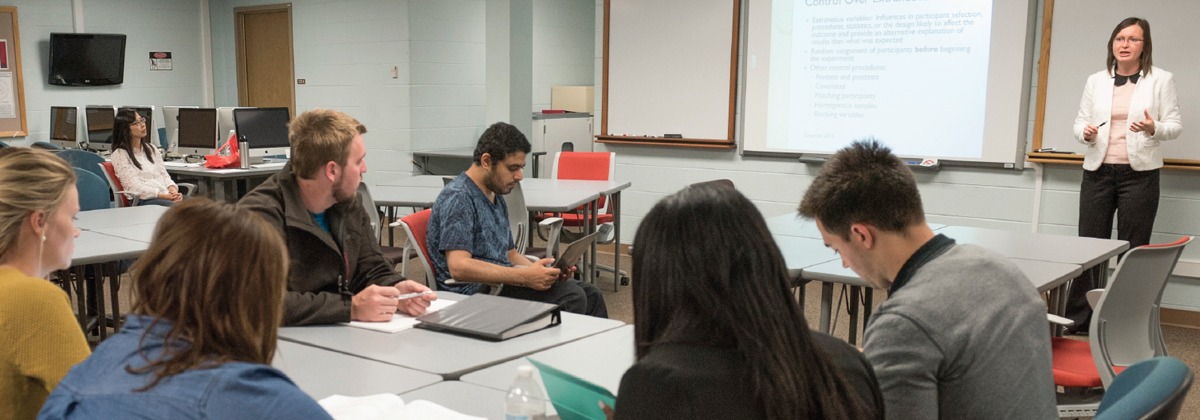


Faculty

Our faculty bring diverse experiences, backgrounds, scholarship and expertise in educational research, evaluation and assessment. They’re committed to facilitating engaging learning experiences in and outside the classroom.

More About Our Faculty

Accomplishments

  • Ximena Burgin has been involved in many federal, state and non-profit grant projects, including projects funded by the U.S. Department of Education, the U.S. Department of Labor, the Illinois State Board of Education and the Missouri Foundation for Health.
  • Cynthia Campbell and David Walker are past-presidents of the Mid-Western Educational Research Association, and other faculty are highly engaged in this professional organization.
  • Laura Ruth Johnson published "Community-based Qualitative Research: Approaches for Education and the Social Science" (2017, Sage Publications), which is an internationally recognized text in the field. She was also featured as an expert in community-based qualitative methods in Sage's research methods video series.
  • Todd Reeves was twice recognized for his peer review activity by Publons (Sentinel of Science: Social Science Award in 2016, and Top Reviewer: Social Science in 2017).
  • Thomas Smith was named an NIU Presidential Teaching Professor in 2017 to recognize his excellence in the practice of teaching.
  • Our faculty have published their work in a number of top-tier journals, such as Journal of Applied Statistics; Educational Evaluation and Policy Analysis; Computers & Education; Journal of Educational Measurement: Issues and Practice; Journal of Research on Technology in Education, Teaching and Teacher Education; and Theory Into Practice.
  • Our department is ranked as " Recognized Publishing Activity" by Cabell's 2016 IPA Report. The ranking acknowledges institutions with authors published in journals listed in the " Educational Technology Systems" and " Tests, Measurement and Evaluation" categories. We're one of three public universities in Illinois that hold this ranking, which is currently bestowed on only 120 of 2,000 institutions in the United States.

Contact Us

Department of Learning Innovation, Leadership and Technology
Graham 223
DeKalb, IL 60115
815-753-9339
lilt@niu.edu

Connect With Us