Special Education: Vision Studies (B.S.Ed.)
People who are blind or have visual impairments can succeed in school, at work and in their communities when they receive specialized instruction and support. Our B.S.Ed. in Special Education Vision Studies program prepares students for careers supporting individuals with visual impairments across educational, rehabilitation and community settings. Through coursework and practical experiences, students gain the skills needed to make a meaningful impact while promoting independence and inclusion. Our vision studies program is fully approved by the Association for Education and Rehabilitation of the Blind and Visually Impaired, Council for Exceptional Children and the Illinois State Board of Education.
Requirements
When you are admitted to NIU to pursue the B.S.Ed. degree in Special Education you'll enter directly into the major program.
- Admission to teacher education and retention in this major require a university GPA of 2.5.
- Grades of C or better are required in specific major courses.
- You must meet all ISBE testing requirements for teacher licensure.
Focus Areas
Children pre-K through 22 Years of Age
As you earn your Illinois teaching license with an endorsement in visual impairments, you'll learn to teach students who are blind or have low vision in a variety of educational settings. You'll develop expertise in assistive technology, accessible instruction and inclusive practices that support participation in schools and communities. Coursework also prepares you to align instruction with academic standards and incorporate individualized goals into students' educational programs.
All Ages (birth through any age of senior citizen)
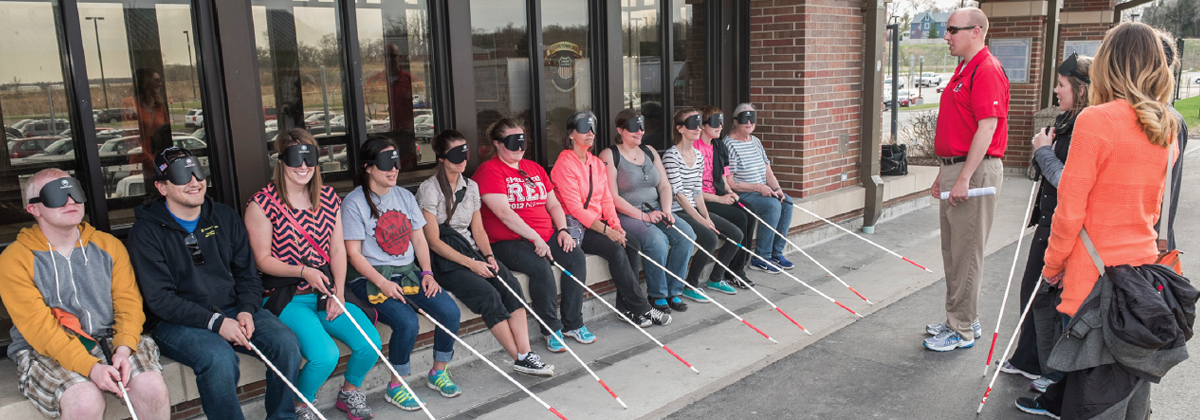
Orientation and mobility specialists teach individuals who are blind or have visual impairments to travel safely and independently. You'll learn to provide instruction in skills such as white cane travel, environmental awareness and route planning in settings ranging from residential programs to unfamiliar community environments.
High School Transition-aged Learners, Adults and Senior Citizens of All Ages
No prior experience working with individuals who are blind or have low vision is required for this specialization. You'll learn strategies for teaching independent living skills that enhance confidence, self-sufficiency and quality of life.
All Ages (birth through any age of senior citizen)
Assistive technology specialists help individuals who are blind or have low vision identify, access and effectively use technology that supports independence at home, school, work and in the community. You'll learn to evaluate technology needs and provide instruction on tools such as screen readers, magnification software, refreshable braille displays and mobile applications.
Licensure and Certification
Depending on your chosen focus area or combination of areas, you may be eligible to pursue the following licensure and certification opportunities:
- Illinois Professional Educator License with an endorsement in Visual Impairments (Teacher of Students with Visual Impairments)
- Orientation and Mobility Specialist (COMS) certification through the Academy for Certification of Vision Rehabilitation and Education Professionals (ACVREP)
- Vision Rehabilitation Therapist (CVRT) certification through ACVREP
- Certified Assistive Technology Instructional Specialist for People with Visual Impairments (CATIS) certification through ACVREP
Coursework
All tracks share a common foundation in visual impairment education, including coursework in braille, assistive technology, low vision, orientation and mobility, anatomy of the eye and professional collaboration. Students then complete specialized coursework and field experiences aligned with their chosen area of study or studies.
Foundational Coursework (Required for All Focus Areas)
- SEVI 410 - Anatomy, Pathology, and Functioning of the Eye (3)
- SEVI 420 - Literary Braille (3)
- SEVI 430 - Basic Orientation and Mobility for Teachers of Persons with Visual Impairments (3)
- SEVI 441 - Instructional Systems for Utilization of Low Vision (3)
- SEVI 447 - Collaboration Principles and Skills for Professionals Working with Persons with Visual Impairments (3)
- SEVI 450 - Assistive Technology for Persons with Visual Impairments (3)
- SEVI 451 - Assistive Technology for Persons with Visual Impairments: Advanced Topics (3)
View full course requirements.
Careers in Special Education Vision Studies
Job prospects for now and the foreseeable future are excellent, particularly if you're willing to relocate. Research has shown that at the current rate of graduation in our field, the United States will not keep up with the needs of visually impaired individuals. Many of our graduates are recruited by the personnel at the sites where they student-teach or intern.
Testimonial
My professors are so supportive and personal. They want us to succeed. This is especially true of Stacy Kelly, one of the most encouraging and enthusiastic teachers I have had. She cares about students, and she knows how to make extremely difficult subjects easier to understand.
Kelly Wakefield, visual impairments major